

How to Style Pakistani Lawn Suits: 2026 UK Style Guide
Table of Contents
- Why Pakistani Lawn Suits Are a Summer Wardrobe Essential
- How to Style a Dupatta with Lawn Suits: 4 Draping Techniques
- Best Accessories for Lawn Suits: Jewellery and Footwear Pairing
- Modern Office Wear Pakistani Suits: Smart Styling for Work
- Styling 3-Piece vs 2-Piece Lawn Suits for Different Occasions
- Age-Appropriate Styling: Adjusting Your Look as You Get Older
- Body-Type Tailoring and Budget-Friendly Styling Hacks
- Caring for Your Lawn Suits So They Last
- Frequently Asked Questions
Last Updated: October 4, 2026
Why Pakistani Lawn Suits Are a Summer Wardrobe Essential
Pakistani lawn suits are the answer to staying cool and elegant when the temperature climbs. Cotton lawn is a finely woven fabric that breathes well, holds a crisp print, and feels light against the skin, which is why it has anchored summer dressing for generations.
This guide from Roxy's Fashion Online walks through how to style Pakistani lawn suits for work, weddings, and everyday wear. Below, we cover dupatta draping, accessories, tailoring, and care, so every outfit looks considered rather than thrown together.
The fabric does most of the heavy lifting. Cotton lawn keeps its shape after washing, takes embroidery cleanly, and works for both casual and formal lawn looks.
How to Style a Dupatta with Lawn Suits: 4 Draping Techniques
The dupatta sets the whole silhouette, so how you drape it matters more than most people think. Four techniques cover almost every occasion, from a quick supermarket run to a formal dinner.
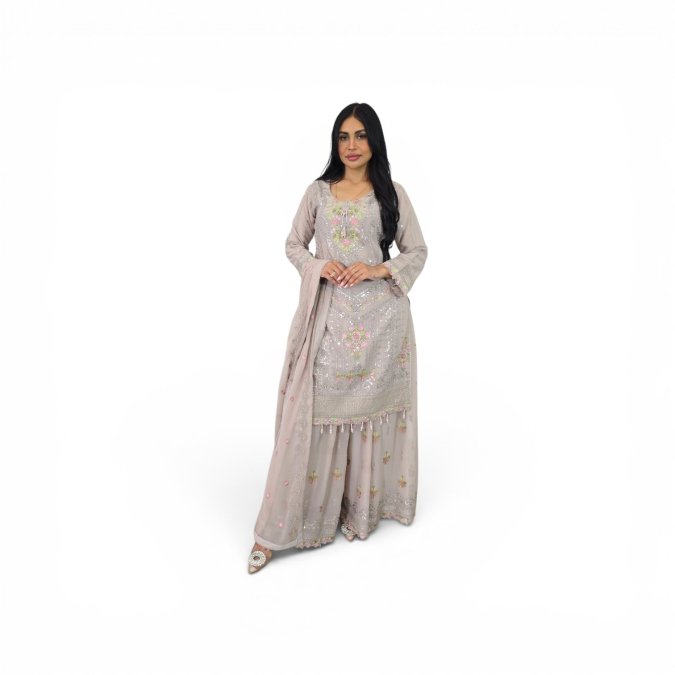
- Shoulder drape - Let the dupatta fall over one shoulder, leaving the other free. Best for daytime and casual chic.
- Both shoulders - Drape evenly across both shoulders for a modest, formal finish.
- Belted - Pin the dupatta at the waist with a slim belt to define the silhouette for evening wear.
- Open front - Leave the dupatta loose at the front, framing embroidery on the neckline and daman.
The Classic Shoulder Drape
The shoulder drape suits almost every body type and never looks fussy. Gather the dupatta at one shoulder, let the rest fall straight, and pin it discreetly at the back so it stays put through the day.
The Belted Dupatta for Formal Occasions
A belted dupatta turns a simple 3-piece suit into evening wear. Choose a slim metallic or beaded belt and place it at the natural waist. This works especially well with a formal lawn suit that has embellishments on the daman.
Best Accessories for Lawn Suits: Jewellery and Footwear Pairing
Accessories decide whether a lawn suit reads casual or dressy. The rule is simple: let one element lead, then keep the rest quiet.
Minimalist Jewellery for Daytime
Daytime calls for small studs, a thin chain, or a single bangle. Heavy jhumkas fight with a busy print. If the kameez has mirror work or crystal detailing on the neck, skip the necklace entirely and let the embroidery speak.
Sandals, Heels and Flats: What Works
Footwear should match the occasion, not the print.
| Occasion | Footwear | Why It Works |
|---|---|---|
| Everyday errands | Flat sandals | Comfortable and easy to walk in |
| Office | Block heels | Smart without being formal |
| Evening party | Heeled sandals | Lifts the silhouette |
| Family gathering | Embellished flats | Dressy but practical |
Modern Office Wear Pakistani Suits: Smart Styling for Work
Modern office wear Pakistani suits work best when the cut is clean and the print is restrained. Choose a straight kameez with plain trousers, then add a structured blazer or a neat cardigan for a fusion styling look that fits a professional setting.
Keep the colour palette tonal: navy, charcoal, beige, or deep green. Save the bold digital prints for weekends. A voile dupatta folded neatly over one shoulder finishes the look without drawing attention.
Styling 3-Piece vs 2-Piece Lawn Suits for Different Occasions
A 3-piece suit gives you a kameez, trousers, and a dupatta, while a 2-piece suit drops the dupatta. The choice is not just about how many pieces you own, it changes the silhouette, the formality level, and how much styling work you do on the day.
What Each Format Actually Does
- 3-piece: The dupatta is the styling lever. It adds vertical lines, covers the shoulders, and lets you shift between casual and formal by changing the drape alone. Best for weddings, formal dinners, and family gatherings where you want the option to dress up or down in the same outfit.
- 2-piece: Cleaner lines and fewer decisions. The kameez and trousers do all the work, so the cut and print must carry the look. Best for work, travel, and long days where a dupatta would need constant adjusting.
- Unstitched: You control the kameez length, sleeve shape, trouser cut, and daman depth. Worth the tailoring cost if standard sizes never sit right on your frame, or if you want a silhouette that is not on the high street this season.
- Ready-to-wear: Sized to a chart, so the fit is predictable but the cut is fixed. Best when you need something quickly and the size chart matches your measurements.
Matching the Format to the Occasion
| Occasion | Format | Why |
|---|---|---|
| Office or commute | 2-piece | No dupatta to manage; layers cleanly under a blazer |
| Daytime family lunch | 3-piece, shoulder drape | Dupatta adds polish without formality |
| Evening dinner | 3-piece, belted | Belt defines the waist and lifts a simple print |
| Wedding guest | 3-piece, both shoulders | Modest, formal, and photograph-friendly |
| Travel | 2-piece | Fewer pieces, less creasing, easier to pack |
Fabric Weight and Dupatta Choice
The dupatta fabric changes the whole outfit. A voile or chiffon dupatta drapes softly and suits belted or open-front styling. A heavier net or organza dupatta holds a structured shape but can overwhelm a light lawn kameez, keep the kameez print simple if the dupatta is heavily embellished. For 2-piece suits, choose a kameez with a slightly heavier lawn or a self-print so the outfit does not read as underwear-adjacent when worn without a dupatta.
Age-Appropriate Styling: Adjusting Your Look as You Get Older
Age-appropriate styling is not about playing it safe. It is about choosing cuts and colours that flatter rather than compete with you, and about fixing the two problems that make lawn suits read as dated: proportions that are too long and prints that are too busy.
Why Lawn Suits Can Look Old-Fashioned
Most lawn suits are cut to a standard block that suits a mid-height, straight frame. On anyone shorter, taller, or curvier, that block produces a kameez that ends at the wrong point, sleeves that sit at the wrong length, and a print that dominates the body. The fix is tailoring, not age.
Adjusting the Cut by Decade
- Twenties and thirties: Shorter kameez lengths (mid-thigh to just above the knee) with straight or cigarette trousers keep the look modern. Small-scale prints and digital motifs work better than large florals.
- Forties and fifties: A kameez that ends at the knee or just below, with a defined waist and a straight or slightly flared trouser, reads elegant without ageing. Three-quarter sleeves are the most flattering sleeve length at this stage.
- Sixties and beyond: Longer kameez lengths, full sleeves, and deeper colours (navy, emerald, burgundy, charcoal) look considered. Keep the print small and the dupatta light so the outfit does not feel heavy.
The Three Adjustments That Matter Most
- Kameez length. The single biggest factor. A kameez that ends at the widest part of the hip or thigh adds visual weight. Move the hem up or down so it ends at a narrow point.
- Sleeve length. Very short sleeves draw attention to the upper arm. Three-quarter or full sleeves lengthen the arm and balance the shoulder line.
- Print scale. Large, high-contrast prints overwhelm. Small, tonal prints read more refined at every age.
Making a Younger Look Work Without Looking Like a Costume
If you want a more current feel, change one element at a time. Swap the dupatta for a plain voile in a contrasting tone. Add a slim belt at the waist. Change the trousers from straight to wide-leg. Each change is small, reversible, and does not require a new suit.
Body-Type Tailoring and Budget-Friendly Styling Hacks
Tailoring is where a lawn suit goes from fine to flattering. A few small adjustments make a big difference.
- Petite frames: Shorten the kameez so it ends above the knee, and keep prints small.
- Curvier shapes: Choose A-line kameez with a defined waist and vertical print placement.
- Taller frames: Straight-cut kameez with wide trousers balance the silhouette.
- All shapes: Check the size chart before ordering and measure your chest, not your usual size.
Budget-friendly styling is easier than it sounds. Restyle one suit three ways with different dupattas, belts, and footwear. Roxy's Fashion Online stocks pieces such as the Zaynash 05 (£19.00), a Swiss lawn printed suit with lace detail, and the Juggan Pink (£26.00), a lawn chikankari suit with mirror work on the neck and sleeves. Both show how far a single suit can stretch with the right styling.

Caring for Your Lawn Suits So They Last
Lawn fabric is delicate, and how you wash it decides how long it lasts. Hand wash in cold water with a mild detergent, or use a gentle machine cycle in a mesh bag. Never wring the fabric; press the water out gently instead.
Dry lawn suits in the shade to protect the print from fading. Iron on a low setting while slightly damp, and always iron the reverse side to avoid scorching embroidery or crystal detailing. Fold rather than hang heavily embellished pieces so the weight does not stretch the shoulders.
Store suits away from direct sunlight, and keep embellished dupattas folded flat with tissue between layers.
Frequently Asked Questions
What are the best accessories to pair with a Pakistani lawn suit?
For daytime, choose minimalist jewellery such as small jhumkas or stud earrings and a thin bangle. A simple clutch or tote works well. For evening events, statement earrings, a layered necklace and embellished sandals or heels add glamour. The key is balancing your accessories with the embroidery and print on your lawn suit. If your suit has heavy neck work, keep jewellery light; if the neckline is plain, you can afford bolder pieces.
How can I style a lawn suit for a formal event?
Choose a 3-piece lawn suit with embroidery or chikankari detailing, such as the Juggan Maroon suit with mirror work on the neck and sleeves. Pair it with a silk or voile dupatta draped elegantly over one shoulder. Add heels, a structured clutch and statement earrings. A belted dupatta instantly elevates the silhouette for formal occasions. Keep your trousers tailored and your overall look polished rather than over-accessorised.
Are lawn suits suitable for office wear?
Yes, lawn suits work well for office wear when styled simply. Opt for a 2-piece or 3-piece suit in muted colours like navy, grey or soft pastels. Skip heavy embellishments and choose plain or lightly embroidered pieces. Pair with flat sandals or block heels, minimal jewellery and a structured tote bag. A straight-cut kameez with plain trousers creates a professional silhouette that meets most workplace dress codes.
How do I modernise the look of a traditional lawn suit?
Try fusion styling: swap the standard dupatta for a belt, pair your kameez with cigarette trousers or culottes instead of traditional shalwar, or add a denim jacket over a simple lawn kurta. Choosing digital print fabrics with contemporary patterns also gives a fresh feel. Experiment with sleeve styles like bell or cape sleeves. These small changes keep the ethnic wear aesthetic while making the outfit feel current and wearable for everyday occasions.
Styling lawn suits well comes down to a few decisions: the right drape, the right accessories, and a fit that actually suits your frame. Roxy's Fashion Online makes that easier with a curated collection of Pakistani dresses and Asian clothing, from casual everyday outfits to formal party wear, all at prices that let you build a proper summer wardrobe. Browse the range to find pieces that fit your size, your occasion, and your budget. VIEW ALL DRESSES