

Pakistani Dresses for Petite Frames: 2026 Style Guide
Table of Contents
- Why Standard Pakistani Dresses Overwhelm Petite Frames
- The Right Kameez Length for Petite Women
- How to Style Shalwar Kameez for Petite Women
- Best Pakistani Suits for Petite Women: Cuts and Silhouettes
- Fabric Choices That Flatter Petite Frames
- Petite Pakistani Formal Wear: Looking Elegant Without Being Overwhelmed
- Tailoring Tips for Pakistani Dresses on Petite Frames
- Conclusion: Dressing Your Petite Frame with Confidence
- Frequently Asked Questions
Last Updated: October 9, 2026
Why Standard Pakistani Dresses Overwhelm Petite Frames
Pakistani dresses for petite frames are garments cut for a shorter vertical line, where proportion, hemline and sleeve length are adjusted so the outfit flatters rather than swamps the wearer. This guide from Roxy's Fashion Online explains how to choose and style them. Most ready-to-wear kameez are drafted for a taller reference height, so a woman of smaller stature ends up with a hem past the knee and a shoulder line that sits too wide.
The fix is rarely "buy a smaller size", sizing down narrows a garment but does not shorten it. Proportion is a vertical question and needs a vertical answer.
The Right Kameez Length for Petite Women
The best kameez length for petite women sits between mid-thigh and just above the knee. That range keeps the leg line visible and stops the shirt from cutting the body into two heavy horizontal blocks.

Three lengths to know:
- Hip-length (short kameez): Ends at the hip bone. Best for casual wear and layering over straight trousers.
- Mid-thigh: Ends roughly 10-15cm above the knee. The most flattering everyday length for a shorter frame.
- Knee-length: Ends at or just above the knee. Works for formal wear when the silhouette below stays narrow.
Anything dropping to mid-calf adds visual weight and shortens the leg. A common mistake is choosing a longer kameez for modesty, then finding the whole outfit reads as heavy.
Measuring for the Perfect Hemline
Measure from the shoulder seam down to where you want the hem to land, not from the collar. Stand in the shoes you plan to wear, since heel height changes the whole line, and compare the number with the garment's stated length before ordering.
How to Style Shalwar Kameez for Petite Women
Learning how to style shalwar kameez for petite women comes down to one principle: keep the eye moving vertically. Vertical detail, a clean neckline and a narrow trouser all push the eye upward.

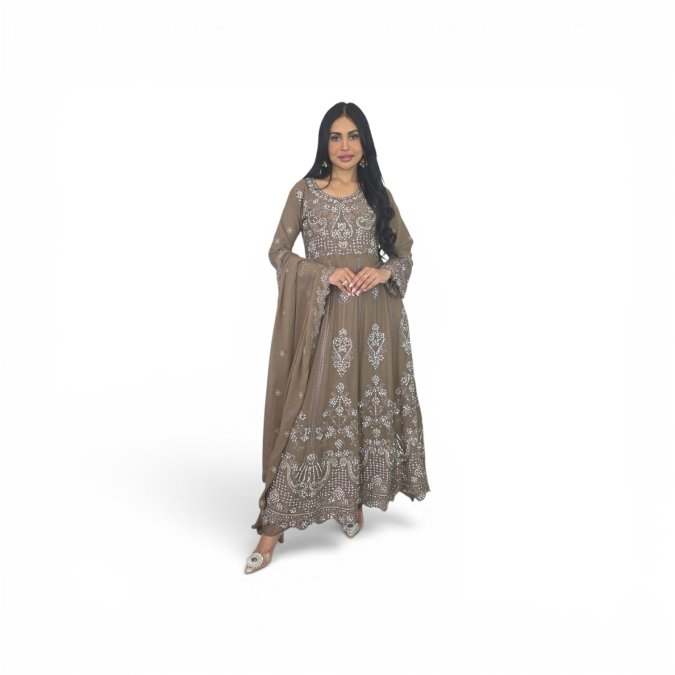
Start with the dupatta: drape it in a single narrow line over one shoulder rather than bunching it across the chest, since a wide gathered drape adds bulk where a shorter frame can least afford it. For a two-shoulder drape, keep both falls narrow and pinned close to the body so they read as two thin vertical stripes.
Footwear and Accessories That Add Height
The kameez sets the proportion; footwear and accessories decide whether it reads as elegant or stunted.
- Heel height: A 5-7cm block or kitten heel is the sweet spot, it lifts the hemline without forcing a re-hem and stays stable for long events. Above 9cm, the foot angles forward, the ankle disappears and the visible leg line shortens.
- Shoe colour: Match the shoe to the trouser or your skin tone, not the kameez. A nude or tonal shoe continues the leg line; a contrast shoe cuts it.
- Pointed or almond toes: A pointed toe extends the leg line; a round or square toe stops it abruptly. With round-toe flats, choose a tonal colour to soften the break.
- Bags: Keep the bag small and carry it high, a clutch under the arm or a short-strap shoulder bag. A large tote at hip level drags the eye down and adds weight at the widest point.
- Jewellery: Choose a single long chain or fine pendant over a chunky collar. A vertical drop repeats the kameez line; a wide collar creates a horizontal band at the neck.
- Hair: An updo or half-up style exposes the neck and adds perceived height. Long hair loose over both shoulders adds width at the shoulder line.
Many petite clients buy the right kameez and then undo it with a large bag and a contrast shoe. Fix the accessories first, it is cheaper than altering the suit.
Choosing the Right Shalwar Cut
The shalwar cut matters as much as the kameez. Straight-cut trousers and cigarette-cut shalwar create an unbroken vertical line. Farshi salwar, with wide floor-sweeping legs, adds volume at the bottom and works against a shorter frame unless the kameez stays short and fitted.
For a middle path, a gently tapered shalwar in soft fabric gives movement without bulk. The trouser should break just once at the ankle rather than pooling, pooling fabric shortens the leg visually and is the most common styling error on a petite frame.
| Shalwar cut | Effect on a petite frame | Best paired with |
|---|---|---|
| Straight / cigarette | Unbroken vertical line, lengthens the leg | Hip-length or mid-thigh kameez |
| Tapered | Movement without bulk | Knee-length kameez |
| Farshi | Adds volume at the floor, shortens the leg | Short, fitted kameez only |
| Paneled sharara | Clean flare that starts below the knee | Short frock suit |
If unsure, start with a straight or cigarette cut in a tonal colour, the most forgiving option and the easiest to alter.
Best Pakistani Suits for Petite Women: Cuts and Silhouettes
The best Pakistani suits for petite women share three traits: a defined waist, a narrow lower half and a hemline that stops above the knee. A-line and angrakha cuts both deliver this.

| Cut | Hemline | Best For | Watch Out For |
|---|---|---|---|
| A-line kameez | Mid-thigh | Casual and semi-formal | Too much flare adds width |
| Angrakha | Knee-length | Weddings and parties | Wrapping adds bulk if over-layered |
| Straight kameez | Hip-length | Everyday wear | Can look boxy without a waist seam |
| Short frock suit | Above knee | Summer and festive | Needs a narrow trouser below |
An A-line kameez with plain paneled sharara pants keeps the top fitted and the bottom clean. A short frock suit cut above the knee with a defined waist is one of the most reliable silhouettes for a smaller frame because it never hides the leg line.
Fabric Choices That Flatter Petite Frames
Fabric selection for petite frames is about weight and drape, not colour. The mechanism is visual weight: a fabric that stands away from the body adds apparent volume, while one that falls close preserves the vertical line. A taller frame has enough vertical distance to absorb that volume; a petite frame does not.
Heavy fabrics hold a shape and look stiff on a small frame; very light clinging fabrics show every line beneath. Aim for a middle weight with good drape that skims rather than clings or stands.
- Lawn and cotton: Light, breathable and hold a crisp edge. Ideal for everyday and summer suits. A crisp lawn in a straight kameez keeps the line clean without adding bulk.
- Silk: Fluid drape that skims rather than clings. Good for semi-formal kameez. Raw silk holds a slight structure, which suits an angrakha; pure silk chiffon drapes more softly and suits a straight cut.
- Velvet: Rich but heavy. Best kept to a short kameez or structured angrakha. A full-length velvet kameez is the most common way a petite frame looks overwhelmed, since the weight pulls the hem down and the pile adds surface volume.
- Organza: Crisp and sheer. Beautiful for a dupatta, risky as a full kameez because it adds volume. On the body, choose a fitted bodice with an organza overlay rather than a full organza shirt.
- Net: Common in embroidered formals. Choose a fitted cut to stop it ballooning; dense embroidery makes net behave like a heavy fabric.
- Chiffon: The most forgiving formal fabric for a petite frame. It drapes close to the body, moves well and does not add bulk even when layered.
How Fabric Weight Interacts With Cut and Season
Fabric does not work in isolation. The velvet that overwhelms a straight kameez works on a short, fitted angrakha because the cut controls the volume, and the lawn that flatters in summer can look flat in winter if the cut is too loose.
A simple rule: the heavier the fabric, the shorter and more fitted the cut should be. The lighter the fabric, the more you can afford a looser silhouette, because the fabric itself will not add bulk.
| Fabric weight | Best cut for a petite frame | Season |
|---|---|---|
| Light (lawn, cotton, chiffon) | Straight, A-line, short frock | Spring / summer |
| Medium (silk, raw silk) | Angrakha, fitted straight | All year |
| Heavy (velvet, dense net, brocade) | Short fitted kameez only | Autumn / winter |
When shopping online, the fabric name alone is not enough. Look for the stated composition and, where available, the fabric weight or a close-up of the drape, a kameez photographed flat always looks lighter than it does on the body.
Petite Pakistani Formal Wear: Looking Elegant Without Being Overwhelmed
Petite Pakistani formal wear works best when the embellishment is concentrated rather than spread. Heavy embroidery across an entire kameez makes a small frame look weighed down.
Choose detail on the front panel, neckline and sleeves, and leave the rest clean. An angrakha style dress with embroidered front and sleeves, plain trousers and an embroidered dupatta gives the occasion its formality without burying the wearer.
Roxy's Fashion Online stocks formal angrakha pieces in net with mirror and stonework on the front and sleeves, which suits this approach well.
Tailoring Tips for Pakistani Dresses on Petite Frames
Tailoring turns a good purchase into a great one. Most ready-to-wear suits need two or three small changes to sit correctly on a shorter frame.
- Shorten the kameez to your measured hemline, keeping the original curve of the hem.
- Take in the shoulder seam if it sits past the natural shoulder point.
- Narrow the sleeve at the wrist; long, wide sleeves shorten the arm.
- Raise the side slits so they start at the hip, not the thigh.
- Check the trouser length against your chosen footwear, not bare feet.
A common mistake is shortening only the kameez and leaving the shalwar pooling at the ankle. Both need attention for the line to read cleanly.
Conclusion: Dressing Your Petite Frame with Confidence
The challenge with Pakistani dresses for petite frames is not a lack of choice; it is a market that drafts for one height and expects everyone else to adapt. Once you know your hemline, shoulder point and preferred drape, the guesswork disappears.
Roxy's Fashion Online offers a curated range of casual, formal and seasonal ethnic wear, with A-line kameez, angrakha formals and short frock suits that suit a shorter frame. Check the stated measurements against your own before ordering, and plan for a small alteration.
Get started with Roxy's Fashion Online and build a wardrobe where every piece fits the frame you actually have.
Frequently Asked Questions
How should a Pakistani dress fit a petite woman?
A Pakistani dress should fit closely through the shoulders and chest without pulling. Shalwar should be tapered rather than baggy. A well-fitted dress for petite Pakistani frames skims the body, avoiding excess fabric that adds visual bulk.
What length should a kameez be for a petite woman?
For petite women, the kameez length is key. Avoid floor-length kameez as they can swamp your frame. If you prefer a longer tunic, ensure the side slits start high to maintain movement and proportion.
Are straight-cut Pakistani suits flattering on petite women?
Yes, straight-cut suits can be very flattering on petite frames. The clean vertical lines create an unbroken visual column that makes you look taller. Pair them with a slim shalwar or cigarette pants. Avoid overly flared or voluminous cuts which can make you appear shorter.
How can petite women choose Pakistani formal wear without looking overwhelmed?
Choose formal wear with delicate embroidery rather than heavy, all-over embellishment. Opt for a single focal point like an embellished neckline or sleeves. A-line or angrakha styles with a defined waist work well. Keep the dupatta light and drape it narrowly to maintain a streamlined silhouette.